
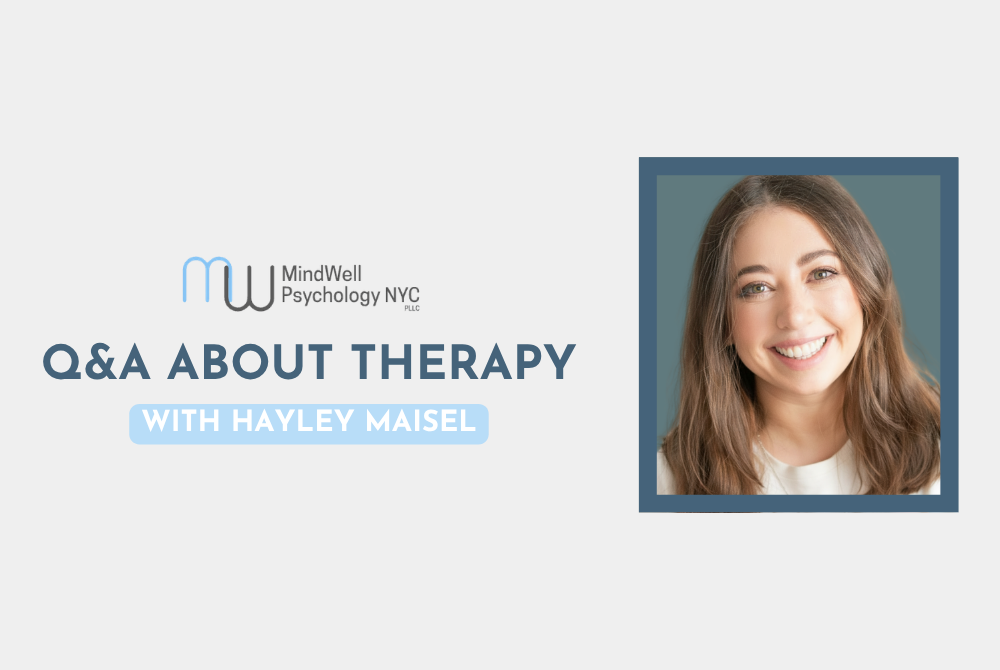
Therapy can be a place to untangle the patterns that keep us stuck and create space for healing, growth, and clarity. In this Q&A, MindWell NYC therapist Haley shares her perspective on helping clients navigate anxiety, relationship challenges, and life transitions with greater self-awareness and compassion. She offers insight into the therapeutic process, what meaningful change can look like, and how building a stronger relationship with yourself can shape every part of your life.
How do you approach emotional intensity in therapy?
Answer: I approach emotional intensity with compassion, curiosity, and without judgment. Many people who experience intense emotions have spent years feeling misunderstood or ashamed of how deeply they feel.
In therapy, we work on recognizing emotions and understanding what they may be communicating to ourselves and others.
Together, we explore emotional patterns, strengthen coping skills, and support navigating overwhelming moments more effectively and with greater self-awareness.
What’s your philosophy on regulating emotions instead of suppressing them?
Answer: I believe emotions are meant to be experienced, not avoided. Suppressing emotions may work temporarily, but over time it often leads to feeling more overwhelmed, disconnected, or stuck.
Emotion regulation is not about “getting rid” of feelings, but about learning how to understand your emotions, respond effectively, and move through them without becoming overwhelmed or consumed by them.
How do you help clients slow things down when feelings spike?
Answer: One of the first things we work on is increasing awareness of what happens emotionally, physically, and mentally before reactions take over. When emotions spike, we often go into survival mode, and it becomes much harder to think clearly.
I help clients learn how to pause, ground themselves, and create space between emotions and reactions so they can respond in ways that align with their goals and values.
What’s one thing you always normalize about big emotions?
Answer: Big emotions are part of the human experience and can happen to anyone. Many people carry shame about feeling deeply, and emotions often make sense in the context of someone’s experiences, relationships, and environment.
One thing I always normalize is that having intense emotions does not mean someone is “too much.” It means there is something important to understand, while also creating opportunities to build skills to respond in ways that feel more effective and supportive.
What makes your work with emotion dysregulation unique?
Answer: What makes my work with emotion dysregulation unique is that I focus on helping people not only manage emotions, but also better understand and trust themselves. Living with intense emotions can be incredibly painful, and many people carry shame around how deeply they feel.
I’m passionate about helping clients feel more understood, more confident in their internal experience, and more capable of responding to emotions in ways that align with the life they want to live. Watching that shift is one of the most meaningful parts of this work.
What approach do you use for eating disorders, and how is it different from just ‘talk therapy’?
Answer: Eating disorder treatment is much more than talking about food or body image. I use evidence-based approaches that address both the eating disorder behaviors and the emotional experiences underneath them. Treatment often includes building more consistent eating patterns, reducing eating disorder behaviors, strengthening coping skills, improving emotion regulation, and exploring themes related to perfectionism, identity, control, and self-worth.
The goal is to help reduce the mental preoccupation with food and body so that individuals can feel more present in their lives and less driven by the eating disorder. I believe treatment works best when it is collaborative, individualized, and grounded in genuine understanding and support.
How do you support someone who isn’t fully ready to recover but knows something needs to change?
Answer: Ambivalence is a very normal part of recovery. Often, eating disorders serve an important emotional function, so letting go of them can feel scary even when someone knows they’re suffering. I approach this without judgment or pressure and meet people where they are in the process.
My goal is to help clients gently explore both what the eating disorder is providing for them and what it may be costing them, while building insight, motivation, and trust at a pace that feels manageable and sustainable.
What does family involvement look like in treatment (especially with FBT)?
Answer: Family involvement is incredibly important, especially when working with adolescents. In FBT, parents (or caregivers) are supported as the primary agents of change in helping restore nutrition and interrupt eating disorder behaviors, while maintaining a compassionate and non-blaming approach.
I work closely with families to provide guidance, education, and support so they feel more confident and less alone in the process, while also helping to reduce shame, fear, and conflict that can often surround the eating disorder. As treatment progresses, we also support the broader emotional recovery of the adolescent and the family system as a whole.
How do you address the emotional side of eating disorders, not just behaviors around food?
Answer: Eating disorders are rarely just about food. They’re often connected to emotions, relationships, perfectionism, identity, self-esteem, and ways of coping with distress. While behavioral change is an important part of recovery, lasting change also involves understanding the emotional experiences underneath the symptoms. In therapy,
I help clients identify what the eating disorder is communicating, and support them in developing healthier ways to cope, communicate, and care for themselves so the eating disorder no longer has to serve that role.
Can therapy help if I don’t have a formal diagnosis but struggle with food, body image, or control?
Answer: Absolutely, you do not need a formal diagnosis to deserve support. Many people experience distress around food, exercise, body image, or control without meeting full diagnostic criteria for an eating disorder.
Therapy can help you build a healthier relationship with food and yourself, reduce shame and anxiety, and better understand the emotional factors contributing to these struggles so they feel less consuming and more manageable.